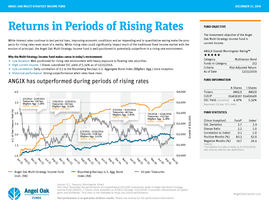
Angel Oak Multi-Strategy Income Fund - Returns in Periods of Rising Rates - December 31, 2016
Angel Oak Capital Advisors

Description
The potential for outperformance across interest rate cycles
Annualized
Total Returns (as of 12/31/16) Prior Qtr.
YTD
1 Year
3 Years
5 Years
Inception2
1.93%
4.28%
4.28%
4.03%
7.54%
8.09%
1.82%
4.08%
4.08%
3.76%
7.32%
7.89%
Class A at MOP
-0.48%
1.78%
1.78%
2.96%
6.84%
7.44%
Index1
-2.98%
2.65%
2.65%
3.03%
2.23%
2.89%
Class I
Class A at NAV
3
About Angel Oak Capital Advisors:
Angel Oak Capital Advisors is an investment management firm focused on providing compelling
fixed income investment solutions for its clients. Backed by a value-driven approach, Angel
Oak Capital seeks to deliver attractive risk-adjusted returns through a combination of stable
current income and price appreciation. Its experienced investment team seeks the best
opportunities in fixed income with a specialization in mortgage-backed securities and other
areas of structured credit. As of 12/31/16, Angel Oak Capital has approximately $5.5 billion
in assets under management through a combination of mutual funds, private funds and
separately managed accounts.
Expense Ratios by Share Class4
Class A
Gross
Net
Class I
1.41%
1.24%
1.19%
0.99%
Current performance may be lower or higher than the performance data quoted.
Performance quoted is past performance and is no guarantee of future results. The investment return and principal value of an investment in the Fund will fluctuate so that an investor’s shares, when redeemed, may be worth more or less than their original cost. Returns shown for A Shares at NAV do not reflect the maximum sales load of 2.25%; if reflected, performance would be lower than shown.
Current performance to the most recent month end can be obtained by calling 855-751-4324. Bloomberg Barclays U.S. Aggregate Bond Index. See below for definition. The inception date of the Angel Oak Multi-Strategy Income Fund A Class (ANGLX) was June 28, 2011, while the inception date of the Institutional Class (ANGIX) was August 16, 2012.
The returns of ANGIX shown for periods prior to the inception date include the returns of ANGLX and are adjusted to reflect the operating expenses of ANGIX. 3 Maximum Offering Price takes into account the 2.25% maximum initial sales charge. 4 Gross expense ratios are reported as of the 5/31/16 prospectus. The net expense ratios are reported as of the 1/31/16 Annual Report and are referenced in the 5/31/16 prospectus. The Adviser has contractually agreed to waive fees through 5/31/17. 1 2 Must be preceded or accompanied by a current prospectus.
To obtain an electronic copy of the prospectus, please visit www.angeloakcapital.com. 30-Day SEC Yield: The SEC yield is an annualized yield based on the most recent 30-day period. For the Angel Oak Multi-Strategy Income Fund, subsidized yields reflect fee waivers in effect. Without such waivers, yields would be reduced.
Unsubsidized yields do not reflect fee waivers in effect. As of 12/31/16, the subsidized and unsubsidized 30-Day SEC yield for ANGLX were 4.97% and 5.02%, respectively, and for ANGIX they were 5.34% and 5.38%, respectively. The unsubsidized SEC yield is higher than the subsidized SEC yield due to the Fund recouping previously waived expenses. Bloomberg Barclays U.S.
Aggregate Bond Index: An unmanaged index that measures the performance of the investment-grade universe of bonds issued in the United States. The index includes institutionally traded U.S. Treasury, government sponsored, mortgage and corporate securities. Please note that an investor cannot invest directly in the index; therefore its performance does not reflect a reduction for fees or expenses incurred in managing a portfolio. Basis point (bps): A unit equal to one hundredth of a percentage point. Correlation: A statistical measure of how two securities move in relation to another.
Index used for comparison is the Bloomberg Barclays U.S. Aggregate Bond Index. Effective Duration: Measures a portfolio’s sensitivity to changes in interest rates. Generally, the longer the effective duration, the greater the price change relative to interest rate movements. Sharpe Ratio: A statistical measure that uses standard deviation and excess return to determine reward per unit of risk.
A higher Sharpe ratio implies a better historical risk-adjusted performance. The Sharpe ratio has been calculated since inception using the 3-month Treasury for the risk-free rate of return. Standard Deviation: A statistical measure of portfolio risk used to measure variability of total return around an average, over a specified period of time. The greater the standard deviation over the period, the wider the variability or range of returns and hence, the greater the fund’s volatility.
The standard deviation has been calculated since inception. Mutual fund investing involves risk. Principal loss is possible. The Fund may make short sales of securities, which involve the risk that losses in securities may exceed the original amount invested.
The Fund may use leverage, which may exaggerate the effect of any increase or decrease in the value of securities in the Fund’s portfolio on the Fund’s Net Asset Value and therefore may increase the volatility of the Fund. Derivatives involve risks different from, and in certain cases, greater than the risks presented by more traditional investments. Investments in debt securities typically decrease when interest rates rise.
This risk is usually greater for longer-term debt securities. Investments in lower rated and non-rated securities present a greater risk of loss to principal and interest than higher rated securities. Investments in asset-backed and mortgage-backed securities include additional risks that investors should be aware of including credit risk, prepayment risk, possible illiquidity and default, as well as increased susceptibility to adverse economic developments.
The Fund will incur higher and duplicative expenses when it invests in mutual funds, ETFs, and other investment companies. For more information on these risks and other risks of the Fund, please see the Prospectus. As of 12/31/16, the Angel Oak Multi-Strategy Income Fund (ANGLX) received a Morningstar rating of 5 stars overall, 4 stars for the three-year period & 5 stars for the five-year period among 213, 213, and 175 multisector bond funds, respectively. For each fund with at least a three-year history, Morningstar calculates a Morningstar Rating™ based on a Morningstar Risk-Adjusted Return measure that accounts for variation in a fund’s monthly performance (including the effects of sales charges, loads, and redemption fees), placing more emphasis on downward variations and rewarding consistent performance.
The top 10% of funds in each category receive 5 stars, the next 22.5% receive 4 stars, the next 35% receive 3 stars, the next 22.5% receive 2 stars and the bottom 10% receive 1 star. (Each share class is counted as a fraction of one fund within this scale and rated separately, which may cause slight variations in the distribution percentages.) The Overall Morningstar Rating for a fund is derived from a weighted average of the performance figures associated with its three-, five- and ten-year (if applicable) Morningstar Rating metrics. Ratings for other share classes may vary. © 2016 Morningstar, Inc.
All Rights Reserved. The information contained herein: (1) is proprietary to Morningstar; (2) may not be copied or distributed; and (3) is not warranted to be accurate, complete or timely. Neither Morningstar nor its content providers are responsible for any damages or losses arising from any use of this information. The Angel Oak Funds are distributed by Quasar Distributors, LLC. Not FDIC Insured May Lose Value Not Bank Guaranteed .
Performance quoted is past performance and is no guarantee of future results. The investment return and principal value of an investment in the Fund will fluctuate so that an investor’s shares, when redeemed, may be worth more or less than their original cost. Returns shown for A Shares at NAV do not reflect the maximum sales load of 2.25%; if reflected, performance would be lower than shown.
Current performance to the most recent month end can be obtained by calling 855-751-4324. Bloomberg Barclays U.S. Aggregate Bond Index. See below for definition. The inception date of the Angel Oak Multi-Strategy Income Fund A Class (ANGLX) was June 28, 2011, while the inception date of the Institutional Class (ANGIX) was August 16, 2012.
The returns of ANGIX shown for periods prior to the inception date include the returns of ANGLX and are adjusted to reflect the operating expenses of ANGIX. 3 Maximum Offering Price takes into account the 2.25% maximum initial sales charge. 4 Gross expense ratios are reported as of the 5/31/16 prospectus. The net expense ratios are reported as of the 1/31/16 Annual Report and are referenced in the 5/31/16 prospectus. The Adviser has contractually agreed to waive fees through 5/31/17. 1 2 Must be preceded or accompanied by a current prospectus.
To obtain an electronic copy of the prospectus, please visit www.angeloakcapital.com. 30-Day SEC Yield: The SEC yield is an annualized yield based on the most recent 30-day period. For the Angel Oak Multi-Strategy Income Fund, subsidized yields reflect fee waivers in effect. Without such waivers, yields would be reduced.
Unsubsidized yields do not reflect fee waivers in effect. As of 12/31/16, the subsidized and unsubsidized 30-Day SEC yield for ANGLX were 4.97% and 5.02%, respectively, and for ANGIX they were 5.34% and 5.38%, respectively. The unsubsidized SEC yield is higher than the subsidized SEC yield due to the Fund recouping previously waived expenses. Bloomberg Barclays U.S.
Aggregate Bond Index: An unmanaged index that measures the performance of the investment-grade universe of bonds issued in the United States. The index includes institutionally traded U.S. Treasury, government sponsored, mortgage and corporate securities. Please note that an investor cannot invest directly in the index; therefore its performance does not reflect a reduction for fees or expenses incurred in managing a portfolio. Basis point (bps): A unit equal to one hundredth of a percentage point. Correlation: A statistical measure of how two securities move in relation to another.
Index used for comparison is the Bloomberg Barclays U.S. Aggregate Bond Index. Effective Duration: Measures a portfolio’s sensitivity to changes in interest rates. Generally, the longer the effective duration, the greater the price change relative to interest rate movements. Sharpe Ratio: A statistical measure that uses standard deviation and excess return to determine reward per unit of risk.
A higher Sharpe ratio implies a better historical risk-adjusted performance. The Sharpe ratio has been calculated since inception using the 3-month Treasury for the risk-free rate of return. Standard Deviation: A statistical measure of portfolio risk used to measure variability of total return around an average, over a specified period of time. The greater the standard deviation over the period, the wider the variability or range of returns and hence, the greater the fund’s volatility.
The standard deviation has been calculated since inception. Mutual fund investing involves risk. Principal loss is possible. The Fund may make short sales of securities, which involve the risk that losses in securities may exceed the original amount invested.
The Fund may use leverage, which may exaggerate the effect of any increase or decrease in the value of securities in the Fund’s portfolio on the Fund’s Net Asset Value and therefore may increase the volatility of the Fund. Derivatives involve risks different from, and in certain cases, greater than the risks presented by more traditional investments. Investments in debt securities typically decrease when interest rates rise.
This risk is usually greater for longer-term debt securities. Investments in lower rated and non-rated securities present a greater risk of loss to principal and interest than higher rated securities. Investments in asset-backed and mortgage-backed securities include additional risks that investors should be aware of including credit risk, prepayment risk, possible illiquidity and default, as well as increased susceptibility to adverse economic developments.
The Fund will incur higher and duplicative expenses when it invests in mutual funds, ETFs, and other investment companies. For more information on these risks and other risks of the Fund, please see the Prospectus. As of 12/31/16, the Angel Oak Multi-Strategy Income Fund (ANGLX) received a Morningstar rating of 5 stars overall, 4 stars for the three-year period & 5 stars for the five-year period among 213, 213, and 175 multisector bond funds, respectively. For each fund with at least a three-year history, Morningstar calculates a Morningstar Rating™ based on a Morningstar Risk-Adjusted Return measure that accounts for variation in a fund’s monthly performance (including the effects of sales charges, loads, and redemption fees), placing more emphasis on downward variations and rewarding consistent performance.
The top 10% of funds in each category receive 5 stars, the next 22.5% receive 4 stars, the next 35% receive 3 stars, the next 22.5% receive 2 stars and the bottom 10% receive 1 star. (Each share class is counted as a fraction of one fund within this scale and rated separately, which may cause slight variations in the distribution percentages.) The Overall Morningstar Rating for a fund is derived from a weighted average of the performance figures associated with its three-, five- and ten-year (if applicable) Morningstar Rating metrics. Ratings for other share classes may vary. © 2016 Morningstar, Inc.
All Rights Reserved. The information contained herein: (1) is proprietary to Morningstar; (2) may not be copied or distributed; and (3) is not warranted to be accurate, complete or timely. Neither Morningstar nor its content providers are responsible for any damages or losses arising from any use of this information. The Angel Oak Funds are distributed by Quasar Distributors, LLC. Not FDIC Insured May Lose Value Not Bank Guaranteed .