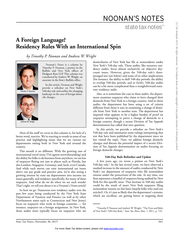
A Foreign Language? Residency Rules With an International Spin - November 30, 2015
Hodgson Russ

Description
Noonan’s Notes
Based on detailed testimony offered by both of the Mays
at the hearing, however, the administrative law judge concluded that May’s actions and general habit of life supported
his claimed change of domicile to the United Kingdom. The
ALJ made several points in his ruling worth highlighting
here:
• A taxpayer may change his or her domicile without
severing all ties with the prior domicile. The guidelines
suggest that moving to a foreign country requires more
New York ties be severed than in other changes of
domicile.
• The department placed undue weight on its regulation,
which required that a taxpayer show his intent to
remain in a foreign country permanently in order to
change his domicile. The department described this
regulation as creating a ‘‘stronger than general’’ regulatory presumption.
The ALJ disagreed and concluded that the same standard must be used in both interstate and international changes of domicile. • Despite factors that might mitigate against May’s claimed change of domicile (that is, his U.S. and U.K. tax returns, his retention of a New York driver’s license, etc.), May’s conduct clearly demonstrated an intent to move the focus of his life from New York to London. Credible testimony offered by both Mr.
and Mrs. May at the hearing certainly helped bolster his position. So this case should be an important one for taxpayers facing the prospect of an audit on a claimed foreign domicile change. This case should also be Exhibit A for the notion that testimony can make all the difference in a domicile case. In May, we see how powerful testimony can be used to overcome a parade of terrible domicile facts that ordinarily 664 would sink a taxpayer.
It’s really quite amazing, and should be a warning signal for residency auditors who often push too hard in these cases. Remember, these domicile cases are all about intent. That’s the key fact. If a taxpayer gets up on the stand and credibly testifies about what he was thinking, more often than not he will win. We’ve seen this in other cases, too, including Knight, Handal, Bostwick, Kaltenbacher-Ross, and Cooke.11 But May is particularly interesting, because it comes up in the context of a foreign domicile change.
In this context the department has historically made it more difficult for a taxpayer to prove his cases by claiming that the burden of proof on the taxpayer claiming the change is higher than normal. Conclusion To borrow a line from the department, residency issues involving foreign countries involve a ‘‘unique set of circumstances.’’ In 548-day audits, the intricacies of that rule often trip up taxpayers seeking its protections. In foreign domicile cases, the department’s attempts to impose a higher standard of proof often make it impossible for a taxpayer to prove his case. However, as the ALJ in May made clear, the unique set of circumstances presented in foreign residency cases does not implicate a different standard for proving a change of domicile.
That determination should force the department to reevaluate the way it analyzes claimed changes of domicile to foreign countries. At a minimum, the department should take note of this determination and ask itself whether the factors it examines and the standard of proof it applies to a claimed foreign domicile change should be any different from those applied in a typical change of domicile. ✰ 11 Matter of Knight, No. 819485 (N.Y.
Div. Tax App. 2006); Matter of Handal, 821996 (N.Y.
Div. Tax App. 2009); Matter of Bostwick, No. 820637 (N.Y.
Div. Tax App. 2007); Matter of Kaltenbacher-Ross, No. 818499 (N.Y.
Div. Tax App. 2003); Matter of Cooke, No.
823591 (N.Y. Div. Tax App. 2012). State Tax Notes, November 30, 2015 For more State Tax Notes content, please visit www.taxnotes.com. (C) Tax Analysts 2015.
All rights reserved. Tax Analysts does not claim copyright in any public domain or third party content. move to the United Kingdom was driven by an offer of employment, though it was not a contractually temporary assignment. Finally, May filed U.K.
tax returns indicating that he was not domiciled in the U.K. So on paper, there were clearly a lot of weaknesses in the case. .
The ALJ disagreed and concluded that the same standard must be used in both interstate and international changes of domicile. • Despite factors that might mitigate against May’s claimed change of domicile (that is, his U.S. and U.K. tax returns, his retention of a New York driver’s license, etc.), May’s conduct clearly demonstrated an intent to move the focus of his life from New York to London. Credible testimony offered by both Mr.
and Mrs. May at the hearing certainly helped bolster his position. So this case should be an important one for taxpayers facing the prospect of an audit on a claimed foreign domicile change. This case should also be Exhibit A for the notion that testimony can make all the difference in a domicile case. In May, we see how powerful testimony can be used to overcome a parade of terrible domicile facts that ordinarily 664 would sink a taxpayer.
It’s really quite amazing, and should be a warning signal for residency auditors who often push too hard in these cases. Remember, these domicile cases are all about intent. That’s the key fact. If a taxpayer gets up on the stand and credibly testifies about what he was thinking, more often than not he will win. We’ve seen this in other cases, too, including Knight, Handal, Bostwick, Kaltenbacher-Ross, and Cooke.11 But May is particularly interesting, because it comes up in the context of a foreign domicile change.
In this context the department has historically made it more difficult for a taxpayer to prove his cases by claiming that the burden of proof on the taxpayer claiming the change is higher than normal. Conclusion To borrow a line from the department, residency issues involving foreign countries involve a ‘‘unique set of circumstances.’’ In 548-day audits, the intricacies of that rule often trip up taxpayers seeking its protections. In foreign domicile cases, the department’s attempts to impose a higher standard of proof often make it impossible for a taxpayer to prove his case. However, as the ALJ in May made clear, the unique set of circumstances presented in foreign residency cases does not implicate a different standard for proving a change of domicile.
That determination should force the department to reevaluate the way it analyzes claimed changes of domicile to foreign countries. At a minimum, the department should take note of this determination and ask itself whether the factors it examines and the standard of proof it applies to a claimed foreign domicile change should be any different from those applied in a typical change of domicile. ✰ 11 Matter of Knight, No. 819485 (N.Y.
Div. Tax App. 2006); Matter of Handal, 821996 (N.Y.
Div. Tax App. 2009); Matter of Bostwick, No. 820637 (N.Y.
Div. Tax App. 2007); Matter of Kaltenbacher-Ross, No. 818499 (N.Y.
Div. Tax App. 2003); Matter of Cooke, No.
823591 (N.Y. Div. Tax App. 2012). State Tax Notes, November 30, 2015 For more State Tax Notes content, please visit www.taxnotes.com. (C) Tax Analysts 2015.
All rights reserved. Tax Analysts does not claim copyright in any public domain or third party content. move to the United Kingdom was driven by an offer of employment, though it was not a contractually temporary assignment. Finally, May filed U.K.
tax returns indicating that he was not domiciled in the U.K. So on paper, there were clearly a lot of weaknesses in the case. .