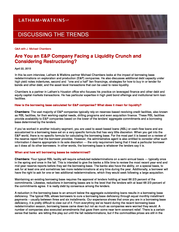
Discussing the Trends - Are You an E&P Company Facing a Liquidity Crunch and Considering Restructuring? – April 22, 2015
Latham & Watkins LLP

Description
What are some key liability management solutions to consider?
Chambers: Liability management solutions are really strategies around how to buy in or tender for bonds and other
debt. One fact investors sometimes don’t fully appreciate is that high yield bond covenants almost never prohibit
buying in your own bonds, so you can do this without restriction. Today, if you are a CFO of a company whose bonds
are trading at US$0.70, you would much rather extinguish that liability at US$0.70 than pay par, which is where you
are carrying it on your balance sheet. There have been a number of deals recently where companies and investors did
exactly that — selling notes back to the company at a discount in exchange for either common stock or new secured
debt of the company.
If it’s part of a significant deleveraging transaction — an exchange of notes for equity for example — our experience is that banks will usually allow that. Surprisingly we haven’t really seen many of these transactions so far. I think a lot of companies are waiting to see what happens in the second half of the year. What type of asset-level transactions can be used to raise liquidity in a distressed situation? Chambers: One of the most common forms of asset level financings are production payments.
In short, a production payment is a present payment for the reserves, which are delivered to the counterparty if and when produced. So the counterparty takes the risk the reserves may not be produced — but the counterparty is also betting that the price of the hydrocarbons will increase above its purchase price. It’s almost like a hedging transaction.
Production payments are a great tool because there is a specific exemption in the bankruptcy code that makes it clear a production payment, properly structured, is a sale of assets from the debtor’s estate — a bankruptcy remote transaction. Farmins and farmouts happen when one party agrees to drill a well and complete it, but they don’t earn an interest in the well until it is completed to an agreed depth. There are some bankruptcy code exceptions here as well. If the company files for chapter 11 before you’ve had a chance to drill the well, as long as the party completes the well as promised, it still receives the property interest, even after chapter 11 has been initiated. We are hearing more about the monetization of commodity hedges than we have in the past.
No one really expected commodity prices to drop into the US$40 to US$50 dollar range. Right now, all hedges should be in the money at this point. That represents a present asset in that those hedges can be unwound for a cash payment to the company. However, producers typically do not have the unilateral right to unwind hedges and so must negotiate with their counterparties for the amount of the early termination payment.
A company can also negotiate with the counterparty to reset the swap price to a lower amount, thereby monetizing a portion of the mark-to-market gain while leaving in place some commodity protection. However, any kind of unwinding of hedges or resetting of the price will almost certainly result in a borrowing base redetermination. For More Information ï‚· ï‚· ï‚· Oil and Gas Restructurings: Exploration and Production Companies Face Unique Issues What Lenders and Investors in E&P Companies Need To Know As Oil Prices Drop Restructurings and Distressed Investing — Planning the Perfect Exit CONTACTS J. Michael Chambers Houston T +1.713.546.7416 michael.chambers@lw.com You Might Also Be Interested In Capital Markets Energy – Oil & Gas Latham & Watkins operates worldwide as a limited liability partnership organized under the laws of the State of Delaware (USA) with affiliated limited liability partnerships conducting the practice in the United Kingdom, France, Italy and Singapore and as affiliated partnerships conducting the practice in Hong Kong and Japan.
The Law Office of Salman M. Al-Sudairi is Latham & Watkins associated office in the Kingdom of Saudi Arabia. In Qatar, Latham & Watkins LLP is licensed by the Qatar Financial Centre Authority. Under New York’s Code of Professional Responsibility, portions of this communication contain attorney advertising.
Prior results do not guarantee a similar outcome. Results depend upon a variety of factors unique to each representation. Please direct all inquiries regarding our conduct under New York’s Disciplinary Rules to Latham & Watkins LLP, 885 Third Avenue, New York, NY 10022-4834, Phone: +1.212.906.1200.
© Copyright 2015 Latham & Watkins. All Rights Reserved. .
If it’s part of a significant deleveraging transaction — an exchange of notes for equity for example — our experience is that banks will usually allow that. Surprisingly we haven’t really seen many of these transactions so far. I think a lot of companies are waiting to see what happens in the second half of the year. What type of asset-level transactions can be used to raise liquidity in a distressed situation? Chambers: One of the most common forms of asset level financings are production payments.
In short, a production payment is a present payment for the reserves, which are delivered to the counterparty if and when produced. So the counterparty takes the risk the reserves may not be produced — but the counterparty is also betting that the price of the hydrocarbons will increase above its purchase price. It’s almost like a hedging transaction.
Production payments are a great tool because there is a specific exemption in the bankruptcy code that makes it clear a production payment, properly structured, is a sale of assets from the debtor’s estate — a bankruptcy remote transaction. Farmins and farmouts happen when one party agrees to drill a well and complete it, but they don’t earn an interest in the well until it is completed to an agreed depth. There are some bankruptcy code exceptions here as well. If the company files for chapter 11 before you’ve had a chance to drill the well, as long as the party completes the well as promised, it still receives the property interest, even after chapter 11 has been initiated. We are hearing more about the monetization of commodity hedges than we have in the past.
No one really expected commodity prices to drop into the US$40 to US$50 dollar range. Right now, all hedges should be in the money at this point. That represents a present asset in that those hedges can be unwound for a cash payment to the company. However, producers typically do not have the unilateral right to unwind hedges and so must negotiate with their counterparties for the amount of the early termination payment.
A company can also negotiate with the counterparty to reset the swap price to a lower amount, thereby monetizing a portion of the mark-to-market gain while leaving in place some commodity protection. However, any kind of unwinding of hedges or resetting of the price will almost certainly result in a borrowing base redetermination. For More Information ï‚· ï‚· ï‚· Oil and Gas Restructurings: Exploration and Production Companies Face Unique Issues What Lenders and Investors in E&P Companies Need To Know As Oil Prices Drop Restructurings and Distressed Investing — Planning the Perfect Exit CONTACTS J. Michael Chambers Houston T +1.713.546.7416 michael.chambers@lw.com You Might Also Be Interested In Capital Markets Energy – Oil & Gas Latham & Watkins operates worldwide as a limited liability partnership organized under the laws of the State of Delaware (USA) with affiliated limited liability partnerships conducting the practice in the United Kingdom, France, Italy and Singapore and as affiliated partnerships conducting the practice in Hong Kong and Japan.
The Law Office of Salman M. Al-Sudairi is Latham & Watkins associated office in the Kingdom of Saudi Arabia. In Qatar, Latham & Watkins LLP is licensed by the Qatar Financial Centre Authority. Under New York’s Code of Professional Responsibility, portions of this communication contain attorney advertising.
Prior results do not guarantee a similar outcome. Results depend upon a variety of factors unique to each representation. Please direct all inquiries regarding our conduct under New York’s Disciplinary Rules to Latham & Watkins LLP, 885 Third Avenue, New York, NY 10022-4834, Phone: +1.212.906.1200.
© Copyright 2015 Latham & Watkins. All Rights Reserved. .