United Planners Financial Services of America Variable Annuity
United Planners Financial Services

Description
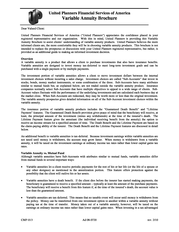
Exchanges
Clients can typically transfer money from one Sub-Account to another without paying taxes on the growth of the
account. Some insurance companies may charge a nominal fee when exchanging between Sub-Accounts, however
most either do not charge a fee or allow a set amount of free trades annually before assessing a charge. In certain
circumstances the insurance company may refuse to place transactions that are deemed violations of their internal
exchange policy.
Tax-Free “1035” Exchanges
Section 1035 of the U.S. Tax Code allows non-qualified variable annuity owners to exchange an existing variable
annuity contract for a new variable annuity contract without paying any tax on the income and investment gains.
Funds must be transferred directly from insurance company to insurance company to (preserve the favorable tax
status), 1035 exchanges can benefit a client when a newer product has features that are preferred, such as a larger
death benefit, different annuity payout options, a wider selection of investment choices, or other provisions that have
benefits not available with the current variable annuity.
Please note that surrender charges still may apply depending on how long the original variable annuity was owned. When considering a 1035 exchange, the client should compare both annuities carefully to determine if the new purchase improves their position by the additional benefits of the new policy. These considerations would include new surrender charge, new internal charges, and new insurance benefits of the policy. Ask Questions before Investing Financial professionals have a duty to make suitable recommendations and client questions regarding investments are encouraged.
Before deciding to buy a variable annuity, consider the following questions: ï‚· Will you use the variable annuity primarily to save for retirement or a similar long-term goal? ï‚· If you are purchasing a variable annuity with qualified money, does the policy satisfy needs other than tax deferment. ï‚· Do you understand the features of the variable annuity? ï‚· Do you understand the fees and expenses of the variable annuity? ï‚· Do you intend to remain in the variable annuity long enough to avoid paying any surrender charges if you have to withdraw more money than the provision of the policy? ï‚· If a variable annuity offers a bonus credit, will the bonus credit outweigh any higher fees and charges that may be assessed? ï‚· Are features of the variable annuity, such as Long-Term Care Insurance, more cost effective if bought inside or outside of the variable annuity? ï‚· If you are exchanging one variable annuity for another one, do the benefits of the exchange outweigh the costs, such as any surrender charges you will have to pay if you withdraw your money before the end of the surrender charge period for the new variable annuity? We suggest clients document the answers to all questions to minimize confusion later. This is a general description of variable annuities – what they are, how they work, and the respective charges, fees and expenses. Before buying any variable annuity read the prospectus carefully.
The prospectus contains important information about the variable annuity contract, including fees and charges, investment options, death benefits, and annuity payout options. Clients also need to consider investments that suit their investment objectives and risk tolerance when making investment choices inside the variable annuity. 4 .
Please note that surrender charges still may apply depending on how long the original variable annuity was owned. When considering a 1035 exchange, the client should compare both annuities carefully to determine if the new purchase improves their position by the additional benefits of the new policy. These considerations would include new surrender charge, new internal charges, and new insurance benefits of the policy. Ask Questions before Investing Financial professionals have a duty to make suitable recommendations and client questions regarding investments are encouraged.
Before deciding to buy a variable annuity, consider the following questions: ï‚· Will you use the variable annuity primarily to save for retirement or a similar long-term goal? ï‚· If you are purchasing a variable annuity with qualified money, does the policy satisfy needs other than tax deferment. ï‚· Do you understand the features of the variable annuity? ï‚· Do you understand the fees and expenses of the variable annuity? ï‚· Do you intend to remain in the variable annuity long enough to avoid paying any surrender charges if you have to withdraw more money than the provision of the policy? ï‚· If a variable annuity offers a bonus credit, will the bonus credit outweigh any higher fees and charges that may be assessed? ï‚· Are features of the variable annuity, such as Long-Term Care Insurance, more cost effective if bought inside or outside of the variable annuity? ï‚· If you are exchanging one variable annuity for another one, do the benefits of the exchange outweigh the costs, such as any surrender charges you will have to pay if you withdraw your money before the end of the surrender charge period for the new variable annuity? We suggest clients document the answers to all questions to minimize confusion later. This is a general description of variable annuities – what they are, how they work, and the respective charges, fees and expenses. Before buying any variable annuity read the prospectus carefully.
The prospectus contains important information about the variable annuity contract, including fees and charges, investment options, death benefits, and annuity payout options. Clients also need to consider investments that suit their investment objectives and risk tolerance when making investment choices inside the variable annuity. 4 .


Sub Categories
United Planners Financial Services


