Description
Compensation Variables
continued
the “lesser losses” issue but can mean that the manager may be allocated more than 20% of the actual profit (in this case,
100%). Note, however, that while the manager is allocated 100% of the profits, the fund results have beat the benchmark by
25%, so the incentive rate works out to be only 8% of the 25 point differential.
As noted above, for most hedge funds that have a hedge component, a pure equity benchmark is probably not appropriate. An index
like the S&P 500 may have had an average annual return of 12% over the last 20 years, but only 4 years were within 5 percentage
points of 12%. 60% of the time, the S&P 500 annual return has been more than 20% or less than zero; it is a highly volatile index.
Accordingly, if reduction of volatility is an objective of the fund, it would not seem logical to tie compensation to a highly volatile index.
As mentioned above, most hurdles, index-related or fixed, reset each year.
Either beginning capital or the beginning high-water mark would be the starting point for the hurdle return calculation. General The characteristics and structure of manager compensation will likely have tax implications for both investors and management. For example, you will note that, in domestic funds, the word “fee” will not normally be associated with incentive compensation (in offshore funds organized as corporations, it’s a different story). In addition, in some jurisdictions, legal counsel may recommend a division of payment – the asset-based fee going to one entity and the incentive allocation to another. Accordingly, it is important to seek competent legal counsel in the drafting stage and to vet documents with the fund’s auditor. Often, a manager may encourage investments by offering a lower management fee or incentive rate for an initial period.
Our systems limit such changes to 3 per year for management fee rates. Note that incentive rate changes must coincide with the end of a stated measurement period. If the incentive is charged annually, the date of any incentive rate change should be January 1. Basic Compensation Parameter Table The following table presents the most common compensation parameters.
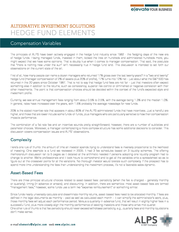
The several bolded selections represent ALPS’ suggestions for best investor appeal and accounting clarity. Asset-based Fee Performance or Incentive Compensation Rate: Rate: o Monthly o Quarterly Period: o Annual o Semi-annual o Quarterly Timing: o Advance o Arrears Limit: o None o Hurdle o Threshold Stated Discounts? o Yes o No Limit Reference or Index: Reference: o Fund $ o Investor $ Limit Rest: Type: o Incremental o Stair-Step Period: o Annual If Stair-Step ratchets? o Yes o No Scheme o Annual o None (cumulative) Limit Calculated o High Water o Capital on beginning: Mark Rate Breakpoint Equity Limits: o limited to profits o charged on lesser losses This material has been prepared by ALPS for general informational purposes only. It does not constitute tax, legal or investment advice, and is presented without any warranty as to its accuracy or completeness or whether it reflects the most current developments. ALPS does not provide tax, legal or investment advice. You are urged to consult your own tax, legal and investment advisors. 5 © 1994 - Present ALPS e-mail e l e m e n t s @ a l p s i n c .
c o m web w w w. a l p s i n c . c o m .
Either beginning capital or the beginning high-water mark would be the starting point for the hurdle return calculation. General The characteristics and structure of manager compensation will likely have tax implications for both investors and management. For example, you will note that, in domestic funds, the word “fee” will not normally be associated with incentive compensation (in offshore funds organized as corporations, it’s a different story). In addition, in some jurisdictions, legal counsel may recommend a division of payment – the asset-based fee going to one entity and the incentive allocation to another. Accordingly, it is important to seek competent legal counsel in the drafting stage and to vet documents with the fund’s auditor. Often, a manager may encourage investments by offering a lower management fee or incentive rate for an initial period.
Our systems limit such changes to 3 per year for management fee rates. Note that incentive rate changes must coincide with the end of a stated measurement period. If the incentive is charged annually, the date of any incentive rate change should be January 1. Basic Compensation Parameter Table The following table presents the most common compensation parameters.
The several bolded selections represent ALPS’ suggestions for best investor appeal and accounting clarity. Asset-based Fee Performance or Incentive Compensation Rate: Rate: o Monthly o Quarterly Period: o Annual o Semi-annual o Quarterly Timing: o Advance o Arrears Limit: o None o Hurdle o Threshold Stated Discounts? o Yes o No Limit Reference or Index: Reference: o Fund $ o Investor $ Limit Rest: Type: o Incremental o Stair-Step Period: o Annual If Stair-Step ratchets? o Yes o No Scheme o Annual o None (cumulative) Limit Calculated o High Water o Capital on beginning: Mark Rate Breakpoint Equity Limits: o limited to profits o charged on lesser losses This material has been prepared by ALPS for general informational purposes only. It does not constitute tax, legal or investment advice, and is presented without any warranty as to its accuracy or completeness or whether it reflects the most current developments. ALPS does not provide tax, legal or investment advice. You are urged to consult your own tax, legal and investment advisors. 5 © 1994 - Present ALPS e-mail e l e m e n t s @ a l p s i n c .
c o m web w w w. a l p s i n c . c o m .