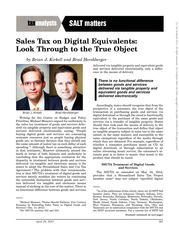
Sales Tax on Digital Equivalents: Look Through to the True Object
RSM US (formerly McGladrey)

Description
SALT Matters
Business 1
Equipment and Supplies Purchased
Business 2
$300,000
$300,000
Sales Tax Paid
0
0
Total Equipment and Supplies Cost
300,000
300,000
Other Costs
600,000
600,000
Total Costs
900,000
900,000
1,000,000
1,000,000
Newspaper Sales Inclusive of Sales Tax
Sales Tax Remitted
Net Income
0
0
100,000
100,000
Source: tables by authors
Business 2, wary of the sales tax treatment it
received under the SSUTA regime, requests guidance from State X regarding the applicability of the
broad manufacturing exemption to its purchases of
tangible property for use in producing its digital
newspaper and the applicability of the newspaper
exemption to its sales of digital newspaper subscriptions to consumers. Based on its new statutory
framework and using the ‘‘true object of the transaction’’ test, State X determines that the purpose of
a consumer in purchasing a newspaper is to read the
news, and finds that this purpose is served regardless of whether the consumer purchases a tangible
newspaper or digital equivalent. Accordingly, State
X advises Business 2 that it will be treated as a
newspaper publisher and its product will be treated
as a newspaper, qualifying its purchases and sales
for both exemptions at issue.
The State X sales tax effect on Business 1 and
Business 2 in this scenario in Table 3.
In this scenario, the sales tax treatment of a
digital newspaper is the same as equivalent tangible
property. No sales tax is paid by either newspaper
publisher on purchases of equipment and supplies,
and no sales tax is charged to consumers.
Taken as a whole, the net result is a level playing field on which the producers of equivalent products earn the same amount of net income under essentially the same facts and circumstances, and sales tax is eliminated as the crucial factor in determining economic winners and losers. Most importantly, consumers can choose based solely on product utility and aesthetic factors, not on price or quality differences driven by inequitable sales tax treatment. ices to sales tax is untenable. Uniformity, fairness, simplicity, and, therefore, compliance have all suffered because SSTP member states apply the SSUTA framework with little consistency (except for excluding digital goods from the definition of tangible property), while other states apply the tangible property approach piecemeal, or avoid the question by not addressing the sales tax treatment of digital goods and services at all.
As illustrated, the proposed cure offered by Mazerov — the universal adoption of the SSUTA — provides no relief from any of those problems, and it should be abandoned in favor of defining digital goods and services as tangible property and approaching the sales tax treatment of those products based on the consumer’s true object in purchasing them. ✰ Brian J. Kirkell is a director in the Washington National Tax office of McGladrey LLP. Brad Hershberger is a partner in McGladrey’s State and Local Tax Practice in Des Moines, Iowa. The information contained herein is general in nature and based on authorities that are subject to change.
This publication does not, and is not intended to, provide legal, tax, or accounting advice, and readers should consult their tax advisers concerning the application of tax laws to their particular situations. This analysis is not tax advice and is not intended or written to be used, and cannot be used, for purposes of avoiding tax penalties that may be imposed on any taxpayer. This article represents the views of the authors only, and does not necessarily represent the views or professional advice of McGladrey. Conclusion There can be little doubt that the status quo in terms of subjecting sales of digital goods and serv- State Tax Notes, April 29, 2013 369 (C) Tax Analysts 2013. All rights reserved.
Tax Analysts does not claim copyright in any public domain or third party content. Table 3. .
Taken as a whole, the net result is a level playing field on which the producers of equivalent products earn the same amount of net income under essentially the same facts and circumstances, and sales tax is eliminated as the crucial factor in determining economic winners and losers. Most importantly, consumers can choose based solely on product utility and aesthetic factors, not on price or quality differences driven by inequitable sales tax treatment. ices to sales tax is untenable. Uniformity, fairness, simplicity, and, therefore, compliance have all suffered because SSTP member states apply the SSUTA framework with little consistency (except for excluding digital goods from the definition of tangible property), while other states apply the tangible property approach piecemeal, or avoid the question by not addressing the sales tax treatment of digital goods and services at all.
As illustrated, the proposed cure offered by Mazerov — the universal adoption of the SSUTA — provides no relief from any of those problems, and it should be abandoned in favor of defining digital goods and services as tangible property and approaching the sales tax treatment of those products based on the consumer’s true object in purchasing them. ✰ Brian J. Kirkell is a director in the Washington National Tax office of McGladrey LLP. Brad Hershberger is a partner in McGladrey’s State and Local Tax Practice in Des Moines, Iowa. The information contained herein is general in nature and based on authorities that are subject to change.
This publication does not, and is not intended to, provide legal, tax, or accounting advice, and readers should consult their tax advisers concerning the application of tax laws to their particular situations. This analysis is not tax advice and is not intended or written to be used, and cannot be used, for purposes of avoiding tax penalties that may be imposed on any taxpayer. This article represents the views of the authors only, and does not necessarily represent the views or professional advice of McGladrey. Conclusion There can be little doubt that the status quo in terms of subjecting sales of digital goods and serv- State Tax Notes, April 29, 2013 369 (C) Tax Analysts 2013. All rights reserved.
Tax Analysts does not claim copyright in any public domain or third party content. Table 3. .