Description
IRAN SANCTIONS
obligations, the complainant may stop
complying with its commitments under the
deal, refer the matter to the Security
Council, or both.
The Security Council may then vote on a
resolution, ostensibly to be conducted in
accordance with normal Security Council
voting procedures. Critically, the resolution
is not to restore sanctions, but instead ‘to
continue the sanctions lifting’. So the veto
right is flipped around from its usual
construction. The complainant, even acting
alone, has the power to veto any attempt to
maintain sanctions.
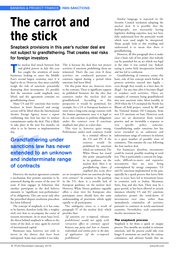
Effectively, no participant state can block the reinstatement of sanctions at the initiative of another participant state, which disrupts the usual way of doing things in the UN Security Council. There is no precedent for a Security Council disenfranchising future Security Councils who may wish to veto a proposal on the basis of the intentions of a single Security Council member. Finally, if the Security Council resolution is not adopted within 30 days of the complaint’s referral, then provisions of the old Security Council resolutions would be reinstated. Confusingly, this is subject to the caveat of ‘unless the Security Council decides otherwise’.
The deal does not set out in any detail what this exception might mean. However its wording suggests that, as a practical matter, reinstating sanctions could be more complex than the short, albeit dense, paragraph on dispute resolution might suggest. Preparing for the worst The main comfort for businesses is that snapback is very unlikely to be employed. It would require Iran to do something so serious IFLR The practical and open approach of IFLR is its great strength and its characteristic contribution to international financial law. “ James Leavy, corporate counsel, Weil Gotshal www.iflr.com as to suggest it wished to be free of the deal in any case.
An example of such a violation would be an increase of the country’s uranium stockpile beyond agreed limitations, which would trigger concerns that it is only doing so to develop a nuclear weapon. If sanctions are snapped back, Iran would immediately walk away from the deal. Indeed, it explicitly makes clear that its government may do so. Iran would, at this point, have had the benefit of many billions “ Effectively, no participant state can block the reinstatement of sanctions at the initiative of another participant state “ responsible for opining in response to a complaint. The snapback process is as follows. A participant to the deal complains to the UN Security Council that another participant has not performed its commitments under the deal. There are no prescribed grounds for snapback.
This permits a large amount of subjectivity on the part of a complainant as to whether an act constitutes significant, non-performance of obligations under the deal. The process is almost certainly intended to address the possibility of the US complaining about Iran, but could also include the UK, Germany, France, or Iran as complainants against any other participant state. A number of stages follow in which a joint commission and advisory board provide opinions on the matter. The joint commission, composed of representatives of each participant state to the deal, would look at the matter and within 15 days would issue its opinion on how it should be resolved.
The time period may be extended by consensus of the joint commission. If the complainant feels that the issue has not been resolved, it can take the matter to the foreign ministers of the participant states. The ministers have 15 days to resolve the complaint, but can agree to extend the timeframe by consensus. At the request of the complainant or the complained-about state, the matter is then delivered to an advisory board composed of one member appointed by the US, one by Iran and a third ‘independent’ member.
They issue a non-binding opinion, which must be delivered within 15 days. If the matter is not resolved, the joint commission has five days to consider the board’s opinion. This takes the process to at least 35 days, and up to 50 days with all of the extensions. There is no guarantee that the various consultations and opinions in these stages would resolve the complaint.
If the complainant holds to its view that Iran has engaged in actions that constitute ‘significant non-performance’ of its of dollars of assets being unfrozen on implementation day (estimates range from $50 billion to $150 billion), and would no longer be restricted under the deal in relation to nuclear activities. Further, sanctions do not work very well unless they comprise co-ordinated efforts between major powers. Imposing new sanctions alone is likely to have very little coercive effect over a target, particularly one that is a major regional economy such as Iran. Businesses should consider how to deal with sanctions snapping back in contracts signed with Iranians after implementation day to ensure that, among other things, winding down or exiting Iranian business does not breach contractual arrangements. On this issue, the US Office of Foreign Assets Control has advised US businesses that contract with Iranians include provisions to terminate in full in the event that sanctions are snapped back.
European businesses may also wish to consider doing this to enhance their contractual certainty. Arguably, however, agreeing such terms could be unrealistic. Iranian counterparties may be unwilling to accept the re-imposition of sanctions as a specific termination event in a contract, as they may have little control over the snapback decision. Iranians may therefore also wish to ensure that snapback does not fall within boilerplate force majeure provisions in contracts.
As such, US and European businesses may wish to consider, in practical terms and with detailed strategies, how they would wind-down or exit any Iranian business in the worst-case scenario, given that the nuclear deal offers no grandfathering. By Shearman & Sterling partner Barney Reynolds in London, of counsel Danforth Newcomb in New York, and associate James Campbell in London Read online at iflr.com/snapback IFLR/December/January 2016 2 .
Effectively, no participant state can block the reinstatement of sanctions at the initiative of another participant state, which disrupts the usual way of doing things in the UN Security Council. There is no precedent for a Security Council disenfranchising future Security Councils who may wish to veto a proposal on the basis of the intentions of a single Security Council member. Finally, if the Security Council resolution is not adopted within 30 days of the complaint’s referral, then provisions of the old Security Council resolutions would be reinstated. Confusingly, this is subject to the caveat of ‘unless the Security Council decides otherwise’.
The deal does not set out in any detail what this exception might mean. However its wording suggests that, as a practical matter, reinstating sanctions could be more complex than the short, albeit dense, paragraph on dispute resolution might suggest. Preparing for the worst The main comfort for businesses is that snapback is very unlikely to be employed. It would require Iran to do something so serious IFLR The practical and open approach of IFLR is its great strength and its characteristic contribution to international financial law. “ James Leavy, corporate counsel, Weil Gotshal www.iflr.com as to suggest it wished to be free of the deal in any case.
An example of such a violation would be an increase of the country’s uranium stockpile beyond agreed limitations, which would trigger concerns that it is only doing so to develop a nuclear weapon. If sanctions are snapped back, Iran would immediately walk away from the deal. Indeed, it explicitly makes clear that its government may do so. Iran would, at this point, have had the benefit of many billions “ Effectively, no participant state can block the reinstatement of sanctions at the initiative of another participant state “ responsible for opining in response to a complaint. The snapback process is as follows. A participant to the deal complains to the UN Security Council that another participant has not performed its commitments under the deal. There are no prescribed grounds for snapback.
This permits a large amount of subjectivity on the part of a complainant as to whether an act constitutes significant, non-performance of obligations under the deal. The process is almost certainly intended to address the possibility of the US complaining about Iran, but could also include the UK, Germany, France, or Iran as complainants against any other participant state. A number of stages follow in which a joint commission and advisory board provide opinions on the matter. The joint commission, composed of representatives of each participant state to the deal, would look at the matter and within 15 days would issue its opinion on how it should be resolved.
The time period may be extended by consensus of the joint commission. If the complainant feels that the issue has not been resolved, it can take the matter to the foreign ministers of the participant states. The ministers have 15 days to resolve the complaint, but can agree to extend the timeframe by consensus. At the request of the complainant or the complained-about state, the matter is then delivered to an advisory board composed of one member appointed by the US, one by Iran and a third ‘independent’ member.
They issue a non-binding opinion, which must be delivered within 15 days. If the matter is not resolved, the joint commission has five days to consider the board’s opinion. This takes the process to at least 35 days, and up to 50 days with all of the extensions. There is no guarantee that the various consultations and opinions in these stages would resolve the complaint.
If the complainant holds to its view that Iran has engaged in actions that constitute ‘significant non-performance’ of its of dollars of assets being unfrozen on implementation day (estimates range from $50 billion to $150 billion), and would no longer be restricted under the deal in relation to nuclear activities. Further, sanctions do not work very well unless they comprise co-ordinated efforts between major powers. Imposing new sanctions alone is likely to have very little coercive effect over a target, particularly one that is a major regional economy such as Iran. Businesses should consider how to deal with sanctions snapping back in contracts signed with Iranians after implementation day to ensure that, among other things, winding down or exiting Iranian business does not breach contractual arrangements. On this issue, the US Office of Foreign Assets Control has advised US businesses that contract with Iranians include provisions to terminate in full in the event that sanctions are snapped back.
European businesses may also wish to consider doing this to enhance their contractual certainty. Arguably, however, agreeing such terms could be unrealistic. Iranian counterparties may be unwilling to accept the re-imposition of sanctions as a specific termination event in a contract, as they may have little control over the snapback decision. Iranians may therefore also wish to ensure that snapback does not fall within boilerplate force majeure provisions in contracts.
As such, US and European businesses may wish to consider, in practical terms and with detailed strategies, how they would wind-down or exit any Iranian business in the worst-case scenario, given that the nuclear deal offers no grandfathering. By Shearman & Sterling partner Barney Reynolds in London, of counsel Danforth Newcomb in New York, and associate James Campbell in London Read online at iflr.com/snapback IFLR/December/January 2016 2 .