UN Global Compact - COP - United Nations Global Compact Communication on Progress
Deloitte

Description
UN Global Compact Principle
Disclosure
GRI Indicator
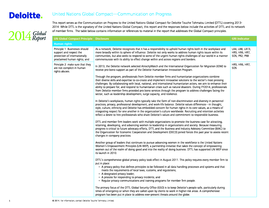
Anti-corruption advocacy
Steve Almond, Chairman of the DTTL Board of Directors, provides DTTL’s engagement in the Forum’s Partnership
Against Corruption Initiative (PACI) Vanguard, a group of 24 business leaders who help shape and inform
the direction and dialogue around a robust anti-corruption agenda. The PACI Vanguard seeks to establish
a framework that can address corruption consistently and lead to more effective enforcement. Currently,
the U.S. member firm serves as an advisor to PACI and is active in a series of projects connecting public and
private initiatives to stamp out corruption in supply chains, as well as improve collaboration between national
governments and local, regional, and multinational organizations.
At the Forum’s May 2014 meeting in Abuja, Nigeria, PACI supported the launch of the Clean Business Practice
Initiative (CBPI), a private-sector-driven anti-corruption initiative that complements government efforts in fighting
corruption in Nigeria.
In addition to its work with the Forum, Deloitte is engaged in global anti-corruption efforts with the G20—through the B20—and the United Nations Global Compact. Deloitte also works with the United Nations Office on Drugs and Crime (UN ODC) and the Organisation for Economic Co-operation and Development (OECD) on specific, country-focused initiatives. Through Deloitte’s Anti-Corruption Academies, governance, anti-corruption, and public-policy professionals provide training on combating corruption, money laundering, and fraud; and inform clients of effective compliance and internal-control programs. During the past fiscal year, Deloitte member firms launched AntiCorruption Academies in Brazil, Chile, Mexico, United Arab Emirates, and Indonesia; additional Academies are being scheduled in South America and Europe in FY2015. Deloitte is an active participant in the dynamic regulatory and public-policy discussions around the world.
Deloitte professionals engage with key stakeholders—government, political, business, and civil society—to contribute to policy development that promotes investor confidence, facilitates cross-border business growth, and supports economic success, growth, resilience, and sustainability. Examples of issues where Deloitte contributes its capabilities include: responsible taxation; corporate governance; immigration and the mobility of people; anti-corruption; technology and security; jobs and skills, including youth employment; trade and investment; and women in the economy. Ethics go to the heart of our work, people, and role in society. That’s why DTTL’s Global Ethics team continues to aggressively integrate ethics into key initiatives and processes, stressing quality and consistency of approach across our network. In particular, we have heightened our focus on anti-corruption, creating new guidelines for corruption risk assessment and third-party due diligence. Please see also the “Advancing global economic prosperity and social wellbeing,” “Regulatory and public policy engagement,” and “Ethics” sections of this report for additional information on Deloitte’s commitment to combating corruption. Deloitte refers to one or more of Deloitte Touche Tohmatsu Limited, a UK private company limited by guarantee (“DTTL”), its network of member firms, and their related entities.
DTTL and each of its member firms are legally separate and independent entities. DTTL (also referred to as “Deloitte Global”) does not provide services to clients. Please see www.deloitte.com/about for a more detailed description of DTTL and its member firms. 5 © 2014. For information, contact Deloitte Touche Tohmatsu Limited. .
In addition to its work with the Forum, Deloitte is engaged in global anti-corruption efforts with the G20—through the B20—and the United Nations Global Compact. Deloitte also works with the United Nations Office on Drugs and Crime (UN ODC) and the Organisation for Economic Co-operation and Development (OECD) on specific, country-focused initiatives. Through Deloitte’s Anti-Corruption Academies, governance, anti-corruption, and public-policy professionals provide training on combating corruption, money laundering, and fraud; and inform clients of effective compliance and internal-control programs. During the past fiscal year, Deloitte member firms launched AntiCorruption Academies in Brazil, Chile, Mexico, United Arab Emirates, and Indonesia; additional Academies are being scheduled in South America and Europe in FY2015. Deloitte is an active participant in the dynamic regulatory and public-policy discussions around the world.
Deloitte professionals engage with key stakeholders—government, political, business, and civil society—to contribute to policy development that promotes investor confidence, facilitates cross-border business growth, and supports economic success, growth, resilience, and sustainability. Examples of issues where Deloitte contributes its capabilities include: responsible taxation; corporate governance; immigration and the mobility of people; anti-corruption; technology and security; jobs and skills, including youth employment; trade and investment; and women in the economy. Ethics go to the heart of our work, people, and role in society. That’s why DTTL’s Global Ethics team continues to aggressively integrate ethics into key initiatives and processes, stressing quality and consistency of approach across our network. In particular, we have heightened our focus on anti-corruption, creating new guidelines for corruption risk assessment and third-party due diligence. Please see also the “Advancing global economic prosperity and social wellbeing,” “Regulatory and public policy engagement,” and “Ethics” sections of this report for additional information on Deloitte’s commitment to combating corruption. Deloitte refers to one or more of Deloitte Touche Tohmatsu Limited, a UK private company limited by guarantee (“DTTL”), its network of member firms, and their related entities.
DTTL and each of its member firms are legally separate and independent entities. DTTL (also referred to as “Deloitte Global”) does not provide services to clients. Please see www.deloitte.com/about for a more detailed description of DTTL and its member firms. 5 © 2014. For information, contact Deloitte Touche Tohmatsu Limited. .