Description
40.00%
Internet
Bubble
Investors chase
managed futures
Investors chase
(and miss)
managed futures
Investors forget the crash
and begin to chase stocks
Market
Recovery
Again, investors are
late and chase
stocks...
20.00%
10.00%
0.00%
-10.00%
-20.00%
Stocks -vsManaged Futures
-30.00%
Year
-40.00%
2000
Insurance sales often spike immediately
after a disaster. But eventually sales
begin to taper off and people let their
policies lapse. The same could be said
for portfolio management. Investors
often think about risk management
after the damage is done and turn to
investments such as managed futures.
But eventually they become enamored
with the short-term upswing of the
stock market and stop allocating to
noncorrelated assets—even if they are
doing well, just not as well as stocks.
Financial
Crisis
Bull
Market
30.00%
Return
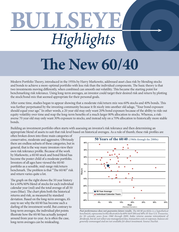
The graph to the right shows the
calendar year performance of domestic
stocks versus managed futures during
the 2000s.
The table below the graph shows the risk/return statistics during the internet bubble, the financial crisis, and the subsequent recovery periods. Although the stock market had some years with large gains, the 10-year average shows that managed futures had seven times the performance of equities with roughly half the volatility. Regardless of any evidence to the contrary, many people still maintain the misconception that managed futures are always riskier than stocks. 2001 2002 2003 Crash & Recovery Market drawdown periods and equal recovery time following 2004 2005 2008 2009 2010 Managed Futures Return Risk Return Risk 17.6% 8.8% 21.0% 22.3% 17.0% 8.3% 23.0% -1.4% 7.3% 8.2% 14.7% 8.4% 16.4% 9.8% 8.5% Internet Bubble Recovery Period Financial Crisis Recovery Period Year 2009 -16.1% 17.2% -37.0% 26.5% 10 Year Average 2001-2010 1.4% Year 2008 2007 Stocks Apr 2000-Mar 2003 Apr 2003-Mar 2006 2006 Performance displayed represents past performance, which is no guarantee of future results. The index returns of Stocks (S&P 500 Index) and Managed Futures (Trader Vic Index) assume reinvestment of all dividends and do not reflect any management fees, transaction costs or expenses. Indexes are generally unmanaged and are not available for direct investment.
Data source: Bloomberg. Summary: Chasing returns simply hasn’t worked for many people. If an investor believes in the long-term merits of stocks as a core investment in their portfolio, it makes sense to consider holding them for the long-term. Managed futures are not without their own risks, including the potential for losses and/or underperformance relative to other investments.
But since they have historically moved differently than stocks, as a part of a portfolio, they may provide diversification benefits. And if an investor believes in the merits of diversification, it doesn’t make sense to chase the returns of managed futures either. One purpose of diversification is to reduce volatility and offset the temptation of fear-based performance chasing. Is it amnesia or something else? Albert Einstein once said, “Insanity is doing the same thing over and over again and expecting a different result.” Investors should do their best to remember how they felt during the market crashes of the past decade and stop repeating the same failed behavior.
They should try harder to remember their own investment objectives and not be so quick to forget about managed futures. Past performance is not indicative of future returns. Historical data is used for statistical illustration purposes only and should not be used as a predictive measure for the future return expectations of any investment. The information is subject to change (based on market fluctuation and other conditions) and should not be construed as a recommendation of any specific security or investment product, and was prepared without regard for specific circumstances and objectives of any individual investor.
Both traditional and alternative investments involve risks, including the potential for loss of principal. Managed futures investments may involve additional risks, including, but not limited to, geopolitical events, supply/ demand fluctuation, futures market speculation and regulatory changes. Before investing in any financial product, always read the prospectus and/or offering memorandum for product-specific risks. Data source: ICI, Morningstar, and Bloomberg. Risk is represented by standard deviation, a statistical measurement of historical price volatility.
The material herein has been provided by Arrow Investment Advisors and is for informational purposes only. Arrow Investment Advisors serves as investment advisor to one or more mutual funds distributed through Northern Lights Distributors, LLC (member FINRA). Northern Lights Distributors, LLC and Arrow Investment Advisors are not affiliated entities. 1654-NLD-8/2/2011 .
The table below the graph shows the risk/return statistics during the internet bubble, the financial crisis, and the subsequent recovery periods. Although the stock market had some years with large gains, the 10-year average shows that managed futures had seven times the performance of equities with roughly half the volatility. Regardless of any evidence to the contrary, many people still maintain the misconception that managed futures are always riskier than stocks. 2001 2002 2003 Crash & Recovery Market drawdown periods and equal recovery time following 2004 2005 2008 2009 2010 Managed Futures Return Risk Return Risk 17.6% 8.8% 21.0% 22.3% 17.0% 8.3% 23.0% -1.4% 7.3% 8.2% 14.7% 8.4% 16.4% 9.8% 8.5% Internet Bubble Recovery Period Financial Crisis Recovery Period Year 2009 -16.1% 17.2% -37.0% 26.5% 10 Year Average 2001-2010 1.4% Year 2008 2007 Stocks Apr 2000-Mar 2003 Apr 2003-Mar 2006 2006 Performance displayed represents past performance, which is no guarantee of future results. The index returns of Stocks (S&P 500 Index) and Managed Futures (Trader Vic Index) assume reinvestment of all dividends and do not reflect any management fees, transaction costs or expenses. Indexes are generally unmanaged and are not available for direct investment.
Data source: Bloomberg. Summary: Chasing returns simply hasn’t worked for many people. If an investor believes in the long-term merits of stocks as a core investment in their portfolio, it makes sense to consider holding them for the long-term. Managed futures are not without their own risks, including the potential for losses and/or underperformance relative to other investments.
But since they have historically moved differently than stocks, as a part of a portfolio, they may provide diversification benefits. And if an investor believes in the merits of diversification, it doesn’t make sense to chase the returns of managed futures either. One purpose of diversification is to reduce volatility and offset the temptation of fear-based performance chasing. Is it amnesia or something else? Albert Einstein once said, “Insanity is doing the same thing over and over again and expecting a different result.” Investors should do their best to remember how they felt during the market crashes of the past decade and stop repeating the same failed behavior.
They should try harder to remember their own investment objectives and not be so quick to forget about managed futures. Past performance is not indicative of future returns. Historical data is used for statistical illustration purposes only and should not be used as a predictive measure for the future return expectations of any investment. The information is subject to change (based on market fluctuation and other conditions) and should not be construed as a recommendation of any specific security or investment product, and was prepared without regard for specific circumstances and objectives of any individual investor.
Both traditional and alternative investments involve risks, including the potential for loss of principal. Managed futures investments may involve additional risks, including, but not limited to, geopolitical events, supply/ demand fluctuation, futures market speculation and regulatory changes. Before investing in any financial product, always read the prospectus and/or offering memorandum for product-specific risks. Data source: ICI, Morningstar, and Bloomberg. Risk is represented by standard deviation, a statistical measurement of historical price volatility.
The material herein has been provided by Arrow Investment Advisors and is for informational purposes only. Arrow Investment Advisors serves as investment advisor to one or more mutual funds distributed through Northern Lights Distributors, LLC (member FINRA). Northern Lights Distributors, LLC and Arrow Investment Advisors are not affiliated entities. 1654-NLD-8/2/2011 .