Description
Many investors like a momentum-based approach because it is systematic and does not allow for a decision making
process subject to speculation and emotions. But that is not to say that it always works. We all know that even the fastest
runner has the potential to stumble. Relative strength strategies do have their periods of pullbacks, which is to be expected,
especially as momentum shifts and market leadership changes.
As a new trend is established, the portfolios must go through an adjustment period during the transition to the new areas of strength—in other words, the slow down period as the runners pass the baton. Choppy or trendless markets can also lead to periods of underperformance until new market leadership is established and a new trend develops. A pure “go anywhere” relative strength strategy may be appealing to investors with a higher risk tolerance, especially when they understand the natural ups and downs of the strategy. Strategic diversification and tactical strategies have long been viewed as opposing philosophies.
Investors have historically faced a line drawn in the sand, having to decide which side they believe in more strongly. But there is an approach which has a common middle ground—tactical diversification. By combining the common sense tenets of diversification with the practical approach of adaptability, tactical diversification seems to be at the intersection of both strategic and tactical portfolio construction.
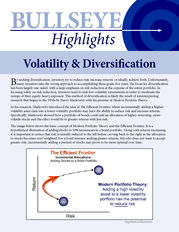
What were once perceived as conflicting approaches, when combined, may actually be quite complementary. Consistent with Modern Portfolio Theory, a tactically diversified portfolio should rely on a blend of multiple asset classes such as stocks, bonds, commodities, and real estate (REITs). Taking a global approach, using both U.S. and international investments, may further enhance the potential for diversification. Based on historical modeling, a range of exposures may be established for each major category to allow for some flexibility.
But the idea of diversification is to maintain at least some exposure to each category at all times. Then, to allow for adaptability, a relative strength approach can be applied within each category. For example, if a portfolio is designed to maintain a constant exposure to stocks, it does not have to include all stocks. There are times when certain stocks, sectors or styles outperform. The idea is to recognize that markets are dynamic and there is a potential value in being adaptive. Tactical Diversification: Modern Portfolio Theory Meets Newton’s Laws of Motion Tactical Strategy Adaptive allocations that adjust to shorter term market environments Tactical Diversification Diversified Strategy Constant allocations to multiple asset classes based on longer term market averages Diversified strategies stem from Modern Portfolio Theory and the idea of blending multiple asset classes.
Tactical strategies, such as relative strength, use the theory of momentum where an object in motion remains in motion until an outside force acts upon it. Tactical diversification relies on both theories. Harry Markowitz, meet Sir Isaac Newton. So, how can this tactical philosophy be applied within a diversified portfolio? A tactically diversified portfolio may apply a relative strength measurement within each asset class in an attempt to identify which specific investments are currently performing the best within their market segment.
On a higher level, the portfolio may also apply a second layer of relative strength at the asset class level to overweight and underweight the allocations within a predetermined minimum/maximum range. The result is a portfolio with constant exposure to a diversified set of asset classes, but with the ability to adapt to ever-changing market environments. Past performance is not indicative of future returns. Historical data may be used for illustrative purposes only and should not be used as a predictive measure for the future return expectations of any investment.
This information is based on hypothetical strategies and should not be construed as a recommendation of any specific security or investment product. The information was prepared without regard for specific circumstances and objectives of any individual investor. Traditional, alternative, tactical and diversified investments all involve risks, including the potential for loss of principal. None of the investment strategies discussed are able to guarantee positive returns over any time period.
Before investing in any financial product, always read the prospectus and/or offering memorandum for general and product-specific risks. 0565-NLD-2/7/2014 .
As a new trend is established, the portfolios must go through an adjustment period during the transition to the new areas of strength—in other words, the slow down period as the runners pass the baton. Choppy or trendless markets can also lead to periods of underperformance until new market leadership is established and a new trend develops. A pure “go anywhere” relative strength strategy may be appealing to investors with a higher risk tolerance, especially when they understand the natural ups and downs of the strategy. Strategic diversification and tactical strategies have long been viewed as opposing philosophies.
Investors have historically faced a line drawn in the sand, having to decide which side they believe in more strongly. But there is an approach which has a common middle ground—tactical diversification. By combining the common sense tenets of diversification with the practical approach of adaptability, tactical diversification seems to be at the intersection of both strategic and tactical portfolio construction.
What were once perceived as conflicting approaches, when combined, may actually be quite complementary. Consistent with Modern Portfolio Theory, a tactically diversified portfolio should rely on a blend of multiple asset classes such as stocks, bonds, commodities, and real estate (REITs). Taking a global approach, using both U.S. and international investments, may further enhance the potential for diversification. Based on historical modeling, a range of exposures may be established for each major category to allow for some flexibility.
But the idea of diversification is to maintain at least some exposure to each category at all times. Then, to allow for adaptability, a relative strength approach can be applied within each category. For example, if a portfolio is designed to maintain a constant exposure to stocks, it does not have to include all stocks. There are times when certain stocks, sectors or styles outperform. The idea is to recognize that markets are dynamic and there is a potential value in being adaptive. Tactical Diversification: Modern Portfolio Theory Meets Newton’s Laws of Motion Tactical Strategy Adaptive allocations that adjust to shorter term market environments Tactical Diversification Diversified Strategy Constant allocations to multiple asset classes based on longer term market averages Diversified strategies stem from Modern Portfolio Theory and the idea of blending multiple asset classes.
Tactical strategies, such as relative strength, use the theory of momentum where an object in motion remains in motion until an outside force acts upon it. Tactical diversification relies on both theories. Harry Markowitz, meet Sir Isaac Newton. So, how can this tactical philosophy be applied within a diversified portfolio? A tactically diversified portfolio may apply a relative strength measurement within each asset class in an attempt to identify which specific investments are currently performing the best within their market segment.
On a higher level, the portfolio may also apply a second layer of relative strength at the asset class level to overweight and underweight the allocations within a predetermined minimum/maximum range. The result is a portfolio with constant exposure to a diversified set of asset classes, but with the ability to adapt to ever-changing market environments. Past performance is not indicative of future returns. Historical data may be used for illustrative purposes only and should not be used as a predictive measure for the future return expectations of any investment.
This information is based on hypothetical strategies and should not be construed as a recommendation of any specific security or investment product. The information was prepared without regard for specific circumstances and objectives of any individual investor. Traditional, alternative, tactical and diversified investments all involve risks, including the potential for loss of principal. None of the investment strategies discussed are able to guarantee positive returns over any time period.
Before investing in any financial product, always read the prospectus and/or offering memorandum for general and product-specific risks. 0565-NLD-2/7/2014 .