Description
In order to enhance a value-based strategy without contradicting the style, an investor may want to consider using
unrelated investment factors such as momentum. Momentum investing is based on the idea of trend following.
Like Sir Isaac Newton’s theory of momentum, the concept is that an object in motion may remain in motion—but
not forever. Remember, past performance is not an indication of future returns. Momentum strategies simply try to
look at past performance to identify a trend in the early stages with the hope that it continues.
It’s like the difference between a photograph and a movie. Style box analysis is like taking a static snapshot to categorize an investment at a specific moment in time. Momentum strategies use a dynamic process to analyze the movement of an investment across multiple time periods.
Regardless of how an investment is categorized, momentum strategies can measure how they move. There are many ways to measure momentum. Relative strength (RS), for example, is a momentum-based strategy that measures the movement of a predefined group of investments across a period of time. The investments showing the best price movement are said to have the highest relative strength.
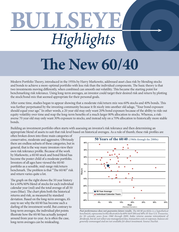
The concept is fairly simple—invest in the ones showing the most relative strength. It is not an analysis of the growth potential of a company, but rather the growth history of the price. Because it stems from an entirely different mind-set based on technical analysis rather than fundamental data, relative strength has the potential to complement a value portfolio rather than contradict it. The graph below illustrates the historical growth of the S&P 500 Value Index, S&P 500 Growth Index and Momentum, based on the Fama-French size/momentum large-cap model (See: http://mba.tuck.dartmouth.edu).
From December 1975 through December 2013, as illustrated below, the Fama-French Large Cap RS Momentum model outpaced the S&P 500’s Value Index, S&P 500 Growth Index and a 50/50 blend of the two which is essentially the S&P 500. For value-based investors, the historical data makes a compelling argument for blending with a momentum strategy. 20000 18000 History of Value, Growth, and Momentum 1975 through 2013 16000 14000 12000 10000 8000 6000 4000 2000 1975 1976 1977 1978 1979 1980 1981 1982 1983 1984 1985 1986 1987 1988 1989 1990 1991 1992 1993 1994 1995 1996 1997 1998 1999 2000 2001 2002 2003 2004 2005 2006 2007 2008 2009 2010 2011 2012 2013 100 S&P 500 Growth Growth/Value Blend S&P 500 Value RS Momentum Value/RS Momentum Blend Past performance is no indication of future returns. The graph above is based on index data and published academic models.
The index and blended data assumes quarterly rebalancing and reinvestment of dividends, but does not include fees. Indexes are not available for direct investment. Data sources: FactSet and Fama-French Data Library, calculated by Arrow. Performance displayed represents past performance, which is no guarantee of future results.
All investment methodologies have risks, both general and product-specific, including the risk of loss of principal investments.The information provided is intended to be general in nature and should not be construed as investment advice. This information is subject to change at anytime, based on market volatility and other conditions, and should not be considered as a recommendation of any specific security. Arrow Funds are distributed by Archer Distributors, LLC (member FINRA). AD-052814 .
It’s like the difference between a photograph and a movie. Style box analysis is like taking a static snapshot to categorize an investment at a specific moment in time. Momentum strategies use a dynamic process to analyze the movement of an investment across multiple time periods.
Regardless of how an investment is categorized, momentum strategies can measure how they move. There are many ways to measure momentum. Relative strength (RS), for example, is a momentum-based strategy that measures the movement of a predefined group of investments across a period of time. The investments showing the best price movement are said to have the highest relative strength.
The concept is fairly simple—invest in the ones showing the most relative strength. It is not an analysis of the growth potential of a company, but rather the growth history of the price. Because it stems from an entirely different mind-set based on technical analysis rather than fundamental data, relative strength has the potential to complement a value portfolio rather than contradict it. The graph below illustrates the historical growth of the S&P 500 Value Index, S&P 500 Growth Index and Momentum, based on the Fama-French size/momentum large-cap model (See: http://mba.tuck.dartmouth.edu).
From December 1975 through December 2013, as illustrated below, the Fama-French Large Cap RS Momentum model outpaced the S&P 500’s Value Index, S&P 500 Growth Index and a 50/50 blend of the two which is essentially the S&P 500. For value-based investors, the historical data makes a compelling argument for blending with a momentum strategy. 20000 18000 History of Value, Growth, and Momentum 1975 through 2013 16000 14000 12000 10000 8000 6000 4000 2000 1975 1976 1977 1978 1979 1980 1981 1982 1983 1984 1985 1986 1987 1988 1989 1990 1991 1992 1993 1994 1995 1996 1997 1998 1999 2000 2001 2002 2003 2004 2005 2006 2007 2008 2009 2010 2011 2012 2013 100 S&P 500 Growth Growth/Value Blend S&P 500 Value RS Momentum Value/RS Momentum Blend Past performance is no indication of future returns. The graph above is based on index data and published academic models.
The index and blended data assumes quarterly rebalancing and reinvestment of dividends, but does not include fees. Indexes are not available for direct investment. Data sources: FactSet and Fama-French Data Library, calculated by Arrow. Performance displayed represents past performance, which is no guarantee of future results.
All investment methodologies have risks, both general and product-specific, including the risk of loss of principal investments.The information provided is intended to be general in nature and should not be construed as investment advice. This information is subject to change at anytime, based on market volatility and other conditions, and should not be considered as a recommendation of any specific security. Arrow Funds are distributed by Archer Distributors, LLC (member FINRA). AD-052814 .