Description
the volatility of an investment can be measured by the amount and frequency that the price moves up and down. For
conservative investors who are seeking to reduce risk, bonds have historically been the diversifier of choice. But with interest
rates near all-time lows, some investors are seeking alternative sources of return other than bonds. When income is not an
objective, managed futures have provided an alternative source of lower-volatility diversification.
The historic returns have been compelling, while also maintaining a low correlation to stocks and bonds. A common comment about commodities is that they are too risky. But for investors with a longer time horizon, or for those with a greater risk tolerance, diversifying through the use of bonds may hinder the ability to generate the desired balance of risk/return. This is where the idea of combining other volatile, but non-correlated investments may make sense.
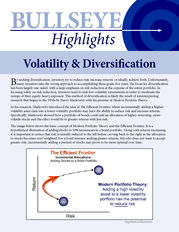
An example might be commodities, which have risk-and-return statistics that seem even more volatile than stocks, but with a low historical correlation. Many investors find it hard to comprehend adding an investment with more historical volatility in order to help to reduce overall risk. The graph below shows the 10-year historical risk/return averages. From the starting point of a 100% stock allocation, the three lines show incremental blended exposure to bonds (red) , managed futures (green) and commodities (blue).
As the image shows, a stock investor could have added bonds to reduce risk, with a somewhat expected result of also reducing return. In retrospect, it would be obvious to most investors to see the potential benefit of managed futures because of the lower risk and higher returns. But it may not have been intuitive to see that allocating approximately 30% to commodities would have garnered similar risk/return characteristics to managed futures where the blue and green lines intersect.
Again, because stocks and commodities often move up and down at different times, there can be significant diversification benefits resulting from the low correlation. Diversification of Stock Exposure 10-Year History (June 2004-June 2014) 16% Managed Futures 14% 12% Commodities Return 10% 8% Stocks 6% 4% Bonds 2% 0% 0% 2% 4% 6% 8% 10% 12% 14% 16% 18% 20% Risk (Standard Deviation) Stock/Commodity Blend Stock/Bond Blend Stock/Managed Futures Blend Past performance is no indication of future returns. The graph above is based on annualized index data as proxies for stocks (S&P 500), bonds (Barclays U.S. Aggregate Bond Index), managed futures (A.I.
Managed Futures Volatility Index) and commodities (Longview Extended Commodity Index). The index data and hypothetical blended portfolios assume reinvestment of dividends, but do not include fees. Indexes are not available for direct investment.
Data sources: FactSet, calculated by Arrow. Past performance is no indication of future returns. All investment methodologies have risks, both general and productspeciï¬c, including the risk of loss of principal. Alternative investments, such as commodities and managed futures, may have additional risks not typically associated with stocks and bonds.
Always read the prospectus or offering memorandum before making any investment. The information provided is intended to be general in nature, not speciï¬c to any product or investor proï¬le, and should not be construed as investment advice. This information is subject to change at anytime, based on market volatility and other conditions, and should not be considered as a recommendation of any speciï¬c security.
Arrow Funds are distributed by Archer Distributors, LLC (member FINRA). AD-091914 .
The historic returns have been compelling, while also maintaining a low correlation to stocks and bonds. A common comment about commodities is that they are too risky. But for investors with a longer time horizon, or for those with a greater risk tolerance, diversifying through the use of bonds may hinder the ability to generate the desired balance of risk/return. This is where the idea of combining other volatile, but non-correlated investments may make sense.
An example might be commodities, which have risk-and-return statistics that seem even more volatile than stocks, but with a low historical correlation. Many investors find it hard to comprehend adding an investment with more historical volatility in order to help to reduce overall risk. The graph below shows the 10-year historical risk/return averages. From the starting point of a 100% stock allocation, the three lines show incremental blended exposure to bonds (red) , managed futures (green) and commodities (blue).
As the image shows, a stock investor could have added bonds to reduce risk, with a somewhat expected result of also reducing return. In retrospect, it would be obvious to most investors to see the potential benefit of managed futures because of the lower risk and higher returns. But it may not have been intuitive to see that allocating approximately 30% to commodities would have garnered similar risk/return characteristics to managed futures where the blue and green lines intersect.
Again, because stocks and commodities often move up and down at different times, there can be significant diversification benefits resulting from the low correlation. Diversification of Stock Exposure 10-Year History (June 2004-June 2014) 16% Managed Futures 14% 12% Commodities Return 10% 8% Stocks 6% 4% Bonds 2% 0% 0% 2% 4% 6% 8% 10% 12% 14% 16% 18% 20% Risk (Standard Deviation) Stock/Commodity Blend Stock/Bond Blend Stock/Managed Futures Blend Past performance is no indication of future returns. The graph above is based on annualized index data as proxies for stocks (S&P 500), bonds (Barclays U.S. Aggregate Bond Index), managed futures (A.I.
Managed Futures Volatility Index) and commodities (Longview Extended Commodity Index). The index data and hypothetical blended portfolios assume reinvestment of dividends, but do not include fees. Indexes are not available for direct investment.
Data sources: FactSet, calculated by Arrow. Past performance is no indication of future returns. All investment methodologies have risks, both general and productspeciï¬c, including the risk of loss of principal. Alternative investments, such as commodities and managed futures, may have additional risks not typically associated with stocks and bonds.
Always read the prospectus or offering memorandum before making any investment. The information provided is intended to be general in nature, not speciï¬c to any product or investor proï¬le, and should not be construed as investment advice. This information is subject to change at anytime, based on market volatility and other conditions, and should not be considered as a recommendation of any speciï¬c security.
Arrow Funds are distributed by Archer Distributors, LLC (member FINRA). AD-091914 .