Description
A Management Tool
In a sports tournament, a team’s ultimate goal is to win. Similar to a team’s management, a portfolio manager may increase
or decrease allocations to existing positions and constantly monitor different asset classes to identify emerging trends.
Likewise, a relative strength portfolio manager uses a tournament approach to narrow a portfolio to a group of the strongest
securities. In the first round of the tournament, securities are grouped and compared by within their asset class to identify
the top-performing representatives. In the second round, relative strength is used to compare the strength of each asset class
to allocate larger (strong relative strength) and smaller (weak relative strength) positions to these asset classes within the
short, intermediate or long-term measurements
U.S.
Equities International either individually or combined, and they Relative Strength Developed: Large Cap Growth can run this test as frequently as they deem Australia France Large Cap Value Tournament Germany Italy necessary. Mid Cap Growth Relative Strength Tournament Mid Cap Value Small Cap Growth Small Cap Value Sectors: -Consumer Goods -Financial Services -Health Care ...etc. Performance in the Market Returns1 60/40 Benchmark Relative Strength Team 1 Month 0.50% 2.50% 3 Months 3.70% 8.00% 1 Year 18.00% 12.50% 3 Years -0.10% 8.60% 5 Years 2.90% 13.00% Japan U.K. Emerging: Brazil China Isreal India Mexico S. Africa S.Korea Taiwan Thailand ...etc. The Final Portfolio Fixed Income Alternatives Commodities: -Aggregated -Agriculture -Energy -Industrial Metals -Precious Metals -Softs Currencies REITs TIPS Corporate Bonds: -Short Term -Intermediate -Long Term -High Yeild U.S. Teasuries: -T-Bills -Treasury Notes -Govt.
Bonds Govt. Agencies Relative Strength Team: The top asset classes in the market performance table (pg. 1) using a combination of applicable indexes measured by intermediate- to long-term relative strength. A Long-term Focus It’s quite rare to see a sports team repeat as champions year after year.
Likewise, an investor’s portfolio doesn’t lead the market year after year. A manager who relies on relative strength to identify portfolio positions will occasionally underperform the market when trends are dramatically changing—the security market is cyclical and sometimes the relative strength measurement period may not align with those short-terms changes. Historically, there tend to be periods of underperformance of relative strength investing followed by periods of strong outperformance. The disciplined relative strength approach helps investors identify and combine the strongest securities, building a winning team over the long term. Relative Strength Team vs.
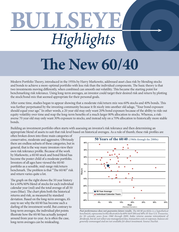
Market Benchmark 35.0% 30.0% 25.0% 20.0% 15.0% 10.0% 5.0% 0.0% -5.0% Rolling Averages -10.0% 1 Year 3 Years 5 -9 3 ec -9 6 D ec -9 7 D ec -9 8 D ec -9 9 D ec -0 0 D ec -0 1 D ec -0 2 D ec -0 3 D ec -0 4 D ec -0 5 D ec -0 6 D ec -0 7 D ec -0 8 D ec -0 9 D ec D -9 ec -9 4 D D ec -9 2 1 -9 ec D ec D -9 ec D ec -8 0 9 -15.0% D The chart to the right illustrates the annualized performance difference of a relative strength approach versus a 60/40 market benchmark over one- and three-year holding periods. Past performance is not indicative of future returns. Historical data is used for statistical illustration purposes only and should not be used as a predictive measure for the future return expectations of any investment. The information provided is intended to be general in nature and should not be construed as investment advice.
The information is subject to change (based on market fluctuation and other conditions) and should not be construed as a recommendation of any specific security or investment product. It was prepared without regard for specific circumstances and objectives of any individual investor. The 60/40 Market Benchmark is 60% S&P 500 Index and 40% Barclays Aggregate Bond Index.
Data source: Morningstar/Ibbotson and Bloomberg as of 12/31/2009. Northern Lights Distributors, LLC, member FINRA. 0392-NLD-3/23/2010 .
Equities International either individually or combined, and they Relative Strength Developed: Large Cap Growth can run this test as frequently as they deem Australia France Large Cap Value Tournament Germany Italy necessary. Mid Cap Growth Relative Strength Tournament Mid Cap Value Small Cap Growth Small Cap Value Sectors: -Consumer Goods -Financial Services -Health Care ...etc. Performance in the Market Returns1 60/40 Benchmark Relative Strength Team 1 Month 0.50% 2.50% 3 Months 3.70% 8.00% 1 Year 18.00% 12.50% 3 Years -0.10% 8.60% 5 Years 2.90% 13.00% Japan U.K. Emerging: Brazil China Isreal India Mexico S. Africa S.Korea Taiwan Thailand ...etc. The Final Portfolio Fixed Income Alternatives Commodities: -Aggregated -Agriculture -Energy -Industrial Metals -Precious Metals -Softs Currencies REITs TIPS Corporate Bonds: -Short Term -Intermediate -Long Term -High Yeild U.S. Teasuries: -T-Bills -Treasury Notes -Govt.
Bonds Govt. Agencies Relative Strength Team: The top asset classes in the market performance table (pg. 1) using a combination of applicable indexes measured by intermediate- to long-term relative strength. A Long-term Focus It’s quite rare to see a sports team repeat as champions year after year.
Likewise, an investor’s portfolio doesn’t lead the market year after year. A manager who relies on relative strength to identify portfolio positions will occasionally underperform the market when trends are dramatically changing—the security market is cyclical and sometimes the relative strength measurement period may not align with those short-terms changes. Historically, there tend to be periods of underperformance of relative strength investing followed by periods of strong outperformance. The disciplined relative strength approach helps investors identify and combine the strongest securities, building a winning team over the long term. Relative Strength Team vs.
Market Benchmark 35.0% 30.0% 25.0% 20.0% 15.0% 10.0% 5.0% 0.0% -5.0% Rolling Averages -10.0% 1 Year 3 Years 5 -9 3 ec -9 6 D ec -9 7 D ec -9 8 D ec -9 9 D ec -0 0 D ec -0 1 D ec -0 2 D ec -0 3 D ec -0 4 D ec -0 5 D ec -0 6 D ec -0 7 D ec -0 8 D ec -0 9 D ec D -9 ec -9 4 D D ec -9 2 1 -9 ec D ec D -9 ec D ec -8 0 9 -15.0% D The chart to the right illustrates the annualized performance difference of a relative strength approach versus a 60/40 market benchmark over one- and three-year holding periods. Past performance is not indicative of future returns. Historical data is used for statistical illustration purposes only and should not be used as a predictive measure for the future return expectations of any investment. The information provided is intended to be general in nature and should not be construed as investment advice.
The information is subject to change (based on market fluctuation and other conditions) and should not be construed as a recommendation of any specific security or investment product. It was prepared without regard for specific circumstances and objectives of any individual investor. The 60/40 Market Benchmark is 60% S&P 500 Index and 40% Barclays Aggregate Bond Index.
Data source: Morningstar/Ibbotson and Bloomberg as of 12/31/2009. Northern Lights Distributors, LLC, member FINRA. 0392-NLD-3/23/2010 .