Description
How much risk are investors facing today? Coming out of the wild swings of 2008 and into 2009, near-term
volatility for equities is at approximately 30% for stocks and 12% for bonds, based on the Volatility Index (VIX) and
options market pricing data. These forward looking estimates seem to be consistent with the market’s measured risk
levels of the past year (which is roughly twice the historical risk level of the previous few decades). Using our bell
curve example based on long-term averages, stocks previously only had a 5% statistical probability of losing -18% at
any given time. But at the current levels of risk, there is a 5% probability of losing -48% or more with stocks.
In the past, a moderately conservative 40/60 portfolio (40% equity and 60% fixed income) with a standard deviation
of 10.8% only had a 5% statistical probability of losing -7.5%.
In today’s market environment, the same moderately conservative 40/60 portfolio would be subject to a blended risk level of 18% standard deviation, based on the risk expectations mentioned above. That means the portfolio would have a 5% probability of losing more than -25% of its value—that’s currently more than three times the historical expected amount of risk for such a conservative portfolio. In fact, based on the VIX and options pricing data, today’s 40/60 portfolio could have greater risk exposure than a 100% equity portfolio had just a few years ago.
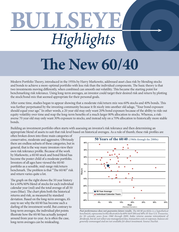
It’s unlikely that the average investor’s risk tolerance has changed that much, but their risk exposure seems to have. CONCLUSION Dow Jones Industrial Average Jan 1920 - Sept 2009 10000 DJIA Level (Logarithmic) The image to the right illustrates the long-term trend lines of the DJIA since the 1920s. It would make sense that an investor might be willing to assume more risk if they honestly believed an investment had the potential to outperform its long-term averages. However, based on this illustration, we can see that equities appear to be in step with their historical averages. Considering that the stock market has already rallied more than 50% from the lows set earlier in the year, investors might be faced with a very difficult question: “Are my return expectations realistically aligned with my risk tolerance?” 1000 100 Historical Return Average +/- One Standard Deviation +/- Two Standard Deviations 10 1920 1930 1940 1950 1960 1970 Calendar Year 1980 1990 2000 Data Source: Bloomberg Understandably, some investors feel the need to play catch-up after the sharp declines of the past few years. But it’s unlikely that their risk tolerance has increased threefold, considering the fact that their risk exposure has potentially tripled.
Do investors have too much equity exposure for their risk tolerance? If stocks fall again, will bonds provide enough of a cushion, if any at all? One solution might be to reassess current portfolio allocations and to consider alternative and tactical investments as a potential hedge against traditional investments. The noncorrelated nature of alternatives provides a complementary source of returns to stocks and bonds, especially when managed to specific risk levels. In changing market environments, trying to achieve risk/return expectations is like trying to hit a moving target.
Alternatives provide a way to focus your aim. Definition of Standard Deviation: A statistical measurement of risk based on historical price volatility. The greater the volatility, the higher the standard deviation (i.e., historical risk). Past performance is not indicative of future returns. Historical and forward looking data is used for statistical illustration purposes only and should not be used as a predictive measure for the future return expectations of any investment.
The information provided is intended to be general in nature and should not be construed as investment advice. The information is subject to change (based on market fluctuation and other conditions) and should not be construed as a recommendation of any specific security or investment product. It was prepared without regard for specific circumstances and objectives of any individual investor.
Data source: Morningstar/Ibbotson and Bloomberg as of 9/30/2009. 1289-NLD-11/2/2009 .
In today’s market environment, the same moderately conservative 40/60 portfolio would be subject to a blended risk level of 18% standard deviation, based on the risk expectations mentioned above. That means the portfolio would have a 5% probability of losing more than -25% of its value—that’s currently more than three times the historical expected amount of risk for such a conservative portfolio. In fact, based on the VIX and options pricing data, today’s 40/60 portfolio could have greater risk exposure than a 100% equity portfolio had just a few years ago.
It’s unlikely that the average investor’s risk tolerance has changed that much, but their risk exposure seems to have. CONCLUSION Dow Jones Industrial Average Jan 1920 - Sept 2009 10000 DJIA Level (Logarithmic) The image to the right illustrates the long-term trend lines of the DJIA since the 1920s. It would make sense that an investor might be willing to assume more risk if they honestly believed an investment had the potential to outperform its long-term averages. However, based on this illustration, we can see that equities appear to be in step with their historical averages. Considering that the stock market has already rallied more than 50% from the lows set earlier in the year, investors might be faced with a very difficult question: “Are my return expectations realistically aligned with my risk tolerance?” 1000 100 Historical Return Average +/- One Standard Deviation +/- Two Standard Deviations 10 1920 1930 1940 1950 1960 1970 Calendar Year 1980 1990 2000 Data Source: Bloomberg Understandably, some investors feel the need to play catch-up after the sharp declines of the past few years. But it’s unlikely that their risk tolerance has increased threefold, considering the fact that their risk exposure has potentially tripled.
Do investors have too much equity exposure for their risk tolerance? If stocks fall again, will bonds provide enough of a cushion, if any at all? One solution might be to reassess current portfolio allocations and to consider alternative and tactical investments as a potential hedge against traditional investments. The noncorrelated nature of alternatives provides a complementary source of returns to stocks and bonds, especially when managed to specific risk levels. In changing market environments, trying to achieve risk/return expectations is like trying to hit a moving target.
Alternatives provide a way to focus your aim. Definition of Standard Deviation: A statistical measurement of risk based on historical price volatility. The greater the volatility, the higher the standard deviation (i.e., historical risk). Past performance is not indicative of future returns. Historical and forward looking data is used for statistical illustration purposes only and should not be used as a predictive measure for the future return expectations of any investment.
The information provided is intended to be general in nature and should not be construed as investment advice. The information is subject to change (based on market fluctuation and other conditions) and should not be construed as a recommendation of any specific security or investment product. It was prepared without regard for specific circumstances and objectives of any individual investor.
Data source: Morningstar/Ibbotson and Bloomberg as of 9/30/2009. 1289-NLD-11/2/2009 .