Description
As we saw in the 50 year illustration, an actual 60/40 portfolio rarely looks like the 60/40’s long-term average. Investors
using target date funds have recently experienced this fact first-hand. Many target date funds work on a “glide path”
where the asset mix is slightly adjusted the closer an investor gets to the target date. For example, if a 20 year old investor
started with an 80/20 portfolio and adjusted the glide path by 1% per year, the result would be a moderate 60/40 portfolio
by age 40.
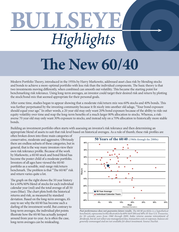
The problem is that a 60/40 portfolio in today’s market has more risk than the 80/20 portfolio did 20 years earlier. This is illustrated in the example below. A 60/40 portfolio has a 20-year average risk level of approximately 11%. But on a shorter three month basis, in order to achieve an 11% risk level, an investor would need to have owned a 30/70 portfolio—requiring an overweight of bonds and far less equity. Long-Term Theory vs.
Short-Term Reality 20 Year Average Conservative “40/60” 7% Risk Moderate “60/40” 11% Risk Aggressive “80/20” 15% Risk 40% Stock 60% Stock 60% Bond 20% Bond 80% Stock Recent 3 Months 22% Stock 40% Bond “The New 60/40” “The New 60/40” 78% Bond 30% Stock 40% Stock 70% Bond 60% Bond 60% Traditional Assets 40% Tactical and Alternatives Past performance does not guarantee future results. The portfolios illustrated are hypothetical. Blended stock (S&P 500) and bond (10-Year U.S.
Treasuries) data are as of 9/30/2011. Risk is represented by Standard Deviation, a statistical measurement of historical price volatility. Historical data used for index returns assume reinvestment of dividends, but do not reflect any management fees, transaction costs or expenses. Indexes are generally unmanaged and are not available for direct investment.
Source: FactSet. Building a portfolio based on long-term averages is like dressing everyday based on the average climate of the region. Despite the average climate, if it is snowing outside, people should be adaptive enough to wear a coat. For investors who still believe in the merits of traditional asset allocation, but are looking for an adaptive element, they may want to consider “The New 60/40” by blending traditional assets with tactical strategies and alternative investments (as illustrated above). Clearly, portfolio modeling based on holding a static mix of stocks and bonds rarely delivers the risk/return characteristics of the long-term averages.
In order to account for ever-changing risk environments, portfolios need to have a tactical element. When constructing a portfolio, investors could consider adding tactical strategies as if they were a separate asset class. The other part of the consideration is to seek alternative assets that go beyond stocks and bonds (e.g., commodities, managed futures, REITs).
Exposure to alternative asset classes adds an extra level of diversification, especially when the performance comes from markets that are unrelated to traditional assets. Obviously, the underlying investment mix would vary depending on the objectives, risk tolerance and time horizon of the individual investor. However, a universal question for all investors remains: If volatility and risk levels are constantly changing, shouldn’t portfolios include at least some form of adaptability and alternative diversification? Past performance is not indicative of future returns. Historical data is used for statistical illustration purposes only and should not be used as a predictive measure for the future return expectations of any investment.
The information is subject to change (based on market fluctuation and other conditions) and should not be construed as a recommendation of any specific security or investment product, and was prepared without regard for specific circumstances and objectives of any individual investor. Both traditional and alternative investments involve risks, including the potential for loss of principal. Absolute return investments may involve additional risks, including, but not limited to, shorting risks, the use of leverage, the use of derivatives, futures market speculation and regulatory changes.
Before investing in any financial product, always read the prospectus and/or offering memorandum for product-specific risks. Data source: FactSet, Lipper, and Bloomberg. “Risk” is represented by Standard Deviation, a statistical measurement of historical price volatility.
Index returns assume reinvestment of dividends, but do not reflect any management fees, transaction costs or expenses. Indexes are generally unmanaged and are not available for direct investment. 0782-NLD-5/21/2012 .
The problem is that a 60/40 portfolio in today’s market has more risk than the 80/20 portfolio did 20 years earlier. This is illustrated in the example below. A 60/40 portfolio has a 20-year average risk level of approximately 11%. But on a shorter three month basis, in order to achieve an 11% risk level, an investor would need to have owned a 30/70 portfolio—requiring an overweight of bonds and far less equity. Long-Term Theory vs.
Short-Term Reality 20 Year Average Conservative “40/60” 7% Risk Moderate “60/40” 11% Risk Aggressive “80/20” 15% Risk 40% Stock 60% Stock 60% Bond 20% Bond 80% Stock Recent 3 Months 22% Stock 40% Bond “The New 60/40” “The New 60/40” 78% Bond 30% Stock 40% Stock 70% Bond 60% Bond 60% Traditional Assets 40% Tactical and Alternatives Past performance does not guarantee future results. The portfolios illustrated are hypothetical. Blended stock (S&P 500) and bond (10-Year U.S.
Treasuries) data are as of 9/30/2011. Risk is represented by Standard Deviation, a statistical measurement of historical price volatility. Historical data used for index returns assume reinvestment of dividends, but do not reflect any management fees, transaction costs or expenses. Indexes are generally unmanaged and are not available for direct investment.
Source: FactSet. Building a portfolio based on long-term averages is like dressing everyday based on the average climate of the region. Despite the average climate, if it is snowing outside, people should be adaptive enough to wear a coat. For investors who still believe in the merits of traditional asset allocation, but are looking for an adaptive element, they may want to consider “The New 60/40” by blending traditional assets with tactical strategies and alternative investments (as illustrated above). Clearly, portfolio modeling based on holding a static mix of stocks and bonds rarely delivers the risk/return characteristics of the long-term averages.
In order to account for ever-changing risk environments, portfolios need to have a tactical element. When constructing a portfolio, investors could consider adding tactical strategies as if they were a separate asset class. The other part of the consideration is to seek alternative assets that go beyond stocks and bonds (e.g., commodities, managed futures, REITs).
Exposure to alternative asset classes adds an extra level of diversification, especially when the performance comes from markets that are unrelated to traditional assets. Obviously, the underlying investment mix would vary depending on the objectives, risk tolerance and time horizon of the individual investor. However, a universal question for all investors remains: If volatility and risk levels are constantly changing, shouldn’t portfolios include at least some form of adaptability and alternative diversification? Past performance is not indicative of future returns. Historical data is used for statistical illustration purposes only and should not be used as a predictive measure for the future return expectations of any investment.
The information is subject to change (based on market fluctuation and other conditions) and should not be construed as a recommendation of any specific security or investment product, and was prepared without regard for specific circumstances and objectives of any individual investor. Both traditional and alternative investments involve risks, including the potential for loss of principal. Absolute return investments may involve additional risks, including, but not limited to, shorting risks, the use of leverage, the use of derivatives, futures market speculation and regulatory changes.
Before investing in any financial product, always read the prospectus and/or offering memorandum for product-specific risks. Data source: FactSet, Lipper, and Bloomberg. “Risk” is represented by Standard Deviation, a statistical measurement of historical price volatility.
Index returns assume reinvestment of dividends, but do not reflect any management fees, transaction costs or expenses. Indexes are generally unmanaged and are not available for direct investment. 0782-NLD-5/21/2012 .